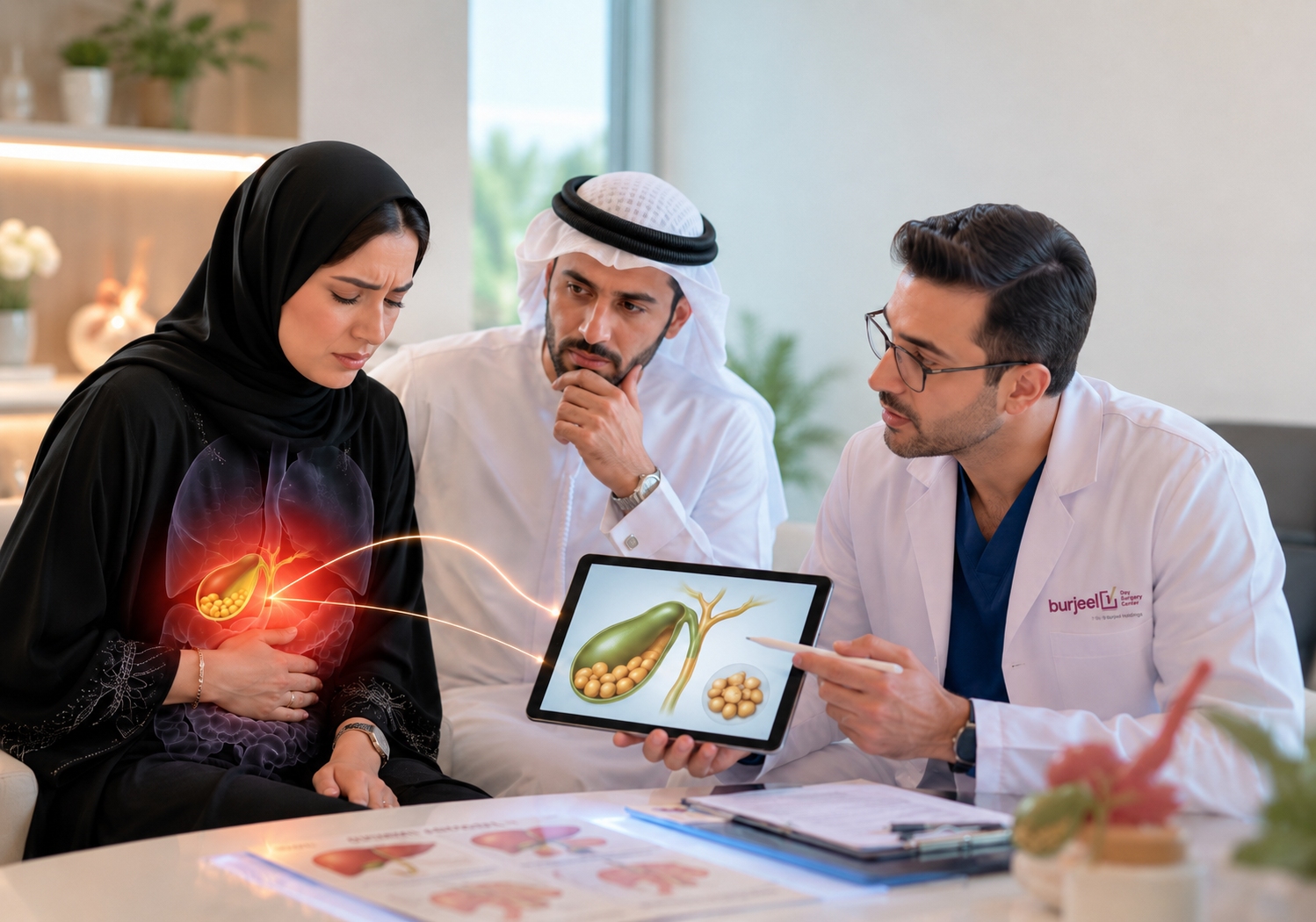
Gallstones are among the most common digestive health problems. They may cause repeated pain in the upper abdomen, especially after fatty meals. Many patients in Al Dhafra and Abu Dhabi search for the cause of this pain and whether it requires medication, monitoring, or laparoscopic gallbladder surgery.
This comprehensive guide explains what gallstones are, their symptoms, causes, diagnosis, treatment options, and when laparoscopic cholecystectomy — also known as laparoscopic gallbladder removal — may be recommended. It also explains when to see a general surgeon, especially for residents of Al Dhafra and nearby areas such as Madinat Zayed, Ruwais, Ghayathi, Liwa, and Al Sila.
Medical Disclaimer: This article is for educational purposes only and does not replace medical consultation. If you have severe or persistent abdominal pain, repeated vomiting, fever, chills, or yellowing of the skin or eyes, seek urgent medical evaluation.
What Is the Gallbladder and What Does It Do?
The gallbladder is a small organ located beneath the liver in the upper right side of the abdomen. Its main role is to store bile, a digestive fluid produced by the liver. Bile helps the body digest fats after meals.
When the balance of bile components changes, or when the gallbladder does not empty properly, solid deposits may form inside the gallbladder. These deposits are called gallstones.
What Are Gallstones?
Gallstones are hardened deposits that form inside the gallbladder or, in some cases, within the bile ducts. They may be as small as grains of sand or larger in size, and a person may have one stone or multiple stones.
Not all gallstones are dangerous or require immediate treatment. Many people have gallstones without symptoms, and they may be discovered incidentally during an abdominal scan performed for another reason.
How Do Gallstones Form?
Gallstones often form when there is an imbalance in the substances that make up bile, such as excess cholesterol, or when the gallbladder does not empty effectively. Over time, these substances can crystallize and form stones.
Some people may have a higher risk of gallstones, including those who are overweight, those who lose weight rapidly, people with a family history of gallstones, and some patients with hormone-related or metabolic risk factors.
Do Gallstones Always Cause Symptoms?
No. Gallstones may be silent and cause no pain or obvious problems. In such cases, a doctor may recommend observation and follow-up rather than immediate treatment.
However, if gallstones begin to cause repeated pain, inflammation, or blockage of the bile ducts, treatment may be needed. In symptomatic cases, laparoscopic surgery may be one of the recommended options after medical evaluation.
Gallbladder Symptoms You Should Not Ignore
The most common symptom of gallbladder disease is pain in the upper abdomen, often on the right side or in the upper middle abdomen. The pain may appear after eating fatty meals.
Common gallbladder and gallstone symptoms include:
- Pain in the upper right abdomen.
- Pain after fatty or heavy meals.
- Pain that may spread to the back or right shoulder.
- Nausea or vomiting.
- Bloating or indigestion.
- Fever if inflammation occurs.
- Yellowing of the skin or eyes if a bile duct becomes blocked.
These symptoms may resemble stomach, acid reflux, or colon-related problems. For this reason, symptoms alone are not enough for diagnosis. Medical examinations are usually needed to identify the cause.
Where Is Gallbladder Pain Felt?
Gallbladder pain is usually felt in the upper right abdomen, beneath the ribs. It may also spread to the back or right shoulder. Some patients describe the pain as sharp, pressure-like, or recurring in attacks.
The pain may occur after meals, especially fatty meals, because the gallbladder contracts to release bile. Gallstones may cause pain if they obstruct the normal flow of bile.
Gallbladder Pain vs. Stomach Pain
Stomach pain often appears in the upper middle abdomen and may be related to acidity, hunger, or certain foods. Gallbladder pain is more commonly felt in the upper right abdomen and may occur after fatty meals or spread to the back or right shoulder.
However, the location of pain is not enough to confirm the diagnosis. Gallbladder symptoms may overlap with gastritis, peptic ulcers, acid reflux, colon problems, liver conditions, or pancreatic disease. A proper medical evaluation is important.
When Are Gallbladder Symptoms an Emergency?
Seek urgent medical evaluation if you experience any of the following:
- Severe or persistent abdominal pain.
- Pain spreading to the back with repeated vomiting.
- Fever or chills.
- Yellowing of the skin or eyes.
- Persistent vomiting.
- Dark urine or pale stools.
- Severe weakness or dizziness with abdominal pain.
These signs may suggest gallbladder inflammation, bile duct blockage, or other complications that require prompt medical care.
How Are Gallstones Diagnosed?
Diagnosis usually begins with a review of symptoms and a clinical examination, followed by tests. Abdominal ultrasound is commonly used to detect gallstones.
Your doctor may also request:
- Blood tests.
- Liver function tests.
- Tests to check for infection or jaundice.
- MRCP or ERCP in selected cases if stones in the bile ducts are suspected.
If stones are found in the bile ducts during ERCP, they may be removed during the same procedure in some cases.
Gallstones Treatment: Does Every Case Need Surgery?
No. Not every case of gallstones requires surgery. If gallstones are not causing symptoms, your doctor may recommend observation and follow-up. If they cause repeated pain, inflammation, or complications, treatment may be necessary.
Treatment depends on:
- Severity of symptoms.
- Frequency of pain attacks.
- Ultrasound and blood test results.
- Presence of inflammation or blockage.
- General health condition of the patient.
- Whether stones are present in the bile ducts.
Treatment Options for Gallstones
1. Medical Observation
If the stones are silent and do not cause pain or complications, your doctor may recommend observation and follow-up rather than immediate treatment.
2. Dietary Changes
Reducing fatty and heavy meals may help decrease pain attacks in some patients, but it does not usually remove existing gallstones.
3. Pain or Inflammation Management
Your doctor may prescribe medications to relieve pain or treat inflammation depending on the case. However, relying on painkillers without evaluating the underlying cause is not recommended if symptoms are recurring.
4. Laparoscopic Gallbladder Removal
If gallstones cause repeated symptoms or complications, laparoscopic gallbladder removal may be recommended. This procedure uses small incisions, a camera, and specialized instruments to remove the gallbladder.
5. Treatment of Bile Duct Stones
If gallstones move into the bile ducts, an ERCP procedure may be needed to remove the stones or relieve the blockage, depending on the doctor’s assessment.
What Is Laparoscopic Gallbladder Surgery?
Laparoscopic gallbladder surgery, also called laparoscopic cholecystectomy, is a procedure in which the gallbladder is removed through several small incisions instead of one large incision. A small camera and surgical instruments are inserted, and the surgeon views the operation on a monitor while removing the gallbladder.
Laparoscopic surgery is usually less invasive than open surgery and may help reduce pain, shorten hospital stay, and support faster recovery in suitable cases.
When Do You Need Laparoscopic Gallbladder Surgery?
Laparoscopic gallbladder surgery may be recommended if gallstones cause:
- Repeated attacks of abdominal pain.
- Gallbladder inflammation.
- Bile duct blockage.
- Jaundice.
- Gallstone-related pancreatitis.
- Significant impact on daily life due to recurring pain.
Gallbladder removal is a common surgical treatment for symptomatic gallstones because stones may continue to recur and cause further attacks if the gallbladder remains in place.
Gallstones Treatment in Al Dhafra: When Should You See a General Surgeon?
If you live in Al Dhafra and experience recurring upper abdominal pain, nausea after meals, or have been diagnosed with gallstones, it is advisable to consult a general surgeon for accurate evaluation.
A medical assessment helps determine whether the stones require monitoring only, symptom management, or laparoscopic gallbladder surgery — especially if symptoms are recurrent or associated with inflammation or bile duct blockage.
The availability of general surgery services in Al Dhafra is especially important for residents of Madinat Zayed, Ruwais, Ghayathi, Liwa, and Al Sila, as it can make evaluation, diagnosis, pre-operative follow-up, and post-operative follow-up more accessible.
Can You Live Without a Gallbladder?
Yes. A person can live without a gallbladder. After removal, bile flows directly from the liver into the intestine instead of being stored in the gallbladder. Most patients gradually return to normal life, although some may need temporary dietary adjustments after surgery.
How to Prepare for Gallbladder Surgery
Before surgery, the doctor reviews symptoms, test results, and the patient’s overall health. Tests may include abdominal ultrasound, blood tests, liver function tests, anesthesia assessment, medication review, and fasting instructions before surgery.
In selected cases, additional tests may be needed if stones in the bile ducts are suspected.
What Happens During Laparoscopic Cholecystectomy?
The procedure is usually performed under general anesthesia. The surgeon makes small incisions in the abdomen, inserts the laparoscope and surgical instruments, separates the gallbladder, and removes it through one of the small incisions. The incisions are then closed, and the patient is monitored in the recovery area.
In some cases, the surgeon may decide to convert to open surgery if there is severe inflammation, adhesions, or unclear anatomy. This decision is made in the patient’s best interest and for safety.
Recovery After Laparoscopic Gallbladder Surgery
Recovery after laparoscopic gallbladder surgery is often faster than open surgery, but recovery time varies from one patient to another. Some patients may experience mild pain at the incision sites, bloating, shoulder discomfort related to the gas used during laparoscopy, or general fatigue in the first few days.
Doctors usually advise gradual movement, wound care, taking prescribed medications, and following diet and activity instructions.
Eating After Gallbladder Removal
After gallbladder removal, patients may be advised to start with light meals and temporarily reduce fatty foods, then gradually return to their usual diet as tolerated. Some patients may experience temporary bloating or digestive changes, which often improve over time.
General dietary tips after surgery:
- Start with light meals.
- Reduce fatty foods at the beginning.
- Eat smaller meals.
- Drink enough fluids.
- Notice which foods trigger symptoms.
- Follow your doctor’s instructions based on your condition.
When Should You Contact the Doctor After Surgery?
Contact your doctor if you notice any of the following after surgery:
- Fever.
- Increase in pain severity.
- Marked redness or discharge from the incision.
- Persistent vomiting.
- Yellowing of the skin or eyes.
- Bleeding or unusual swelling.
- Pain that does not improve with prescribed medication.
Gallstones Treatment and Laparoscopic Gallbladder Surgery at Burjeel Day Surgery Centre, Al Dhafra
The General and Laparoscopic Surgery Department at Burjeel Day Surgery Centre – Al Dhafra evaluates gallbladder conditions and gallstones by reviewing symptoms, imaging results, blood tests, and the patient’s overall health.
The treatment plan may include observation if the stones do not cause symptoms, symptom management, or laparoscopic gallbladder removal if the stones cause recurrent pain, inflammation, or complications.
Dr. Ayham Saied Alhajali, Specialist General Surgery, evaluates surgical and laparoscopic cases within the General Surgery Department at Burjeel Al Dhafra, including gallbladder conditions, hernia, appendicitis, and day surgery procedures.
Frequently Asked Questions (FAQs)
Gallstones may not be dangerous if they do not cause symptoms. However, they can become a problem if they lead to recurrent pain, inflammation, bile duct blockage, or complications such as pancreatitis.
No. Gallstones that do not cause symptoms may not require immediate treatment. Symptomatic gallstones or stones causing complications may require treatment or surgery depending on the doctor’s assessment.
Gallbladder pain often appears in the upper right abdomen, may occur after fatty meals, and may spread to the back or right shoulder. Diagnosis requires medical examinations.
Observation may be enough if gallstones do not cause symptoms. If gallstones cause repeated symptoms or complications, treatment or surgery may be recommended.
Dietary changes may reduce pain attacks in some patients, but they do not usually remove existing gallstones.
Yes. After gallbladder removal, bile flows directly from the liver into the intestine. Some patients may need temporary dietary adjustments after surgery.
Recovery time varies depending on the patient’s condition, but laparoscopic surgery is often associated with faster recovery than open surgery in suitable cases.
Laparoscopic gallbladder removal is a common procedure and usually carries low risks when performed after proper evaluation. Like any surgery, possible complications should be discussed with the doctor.
Seek urgent medical care if pain is severe or persistent, or if it is accompanied by fever, persistent vomiting, yellowing of the skin or eyes, or worsening general condition.
Assessment and treatment of gallbladder conditions are available through the General and Laparoscopic Surgery Department at Burjeel Day Surgery Centre – Al Dhafra. The doctor determines whether laparoscopic gallbladder surgery is appropriate based on symptoms and test results.
You should see a general surgeon if upper abdominal pain is recurrent, especially after fatty meals, or if it is associated with nausea, vomiting, fever, or yellowing of the skin or eyes.
Conclusion
If you have recurring upper abdominal pain, nausea after fatty meals, or have been diagnosed with gallstones, you can visit the General Surgery Department at Burjeel Day Surgery Centre – Al Dhafra for evaluation and to understand whether observation, medical treatment, or laparoscopic gallbladder surgery is the most suitable option for your condition.