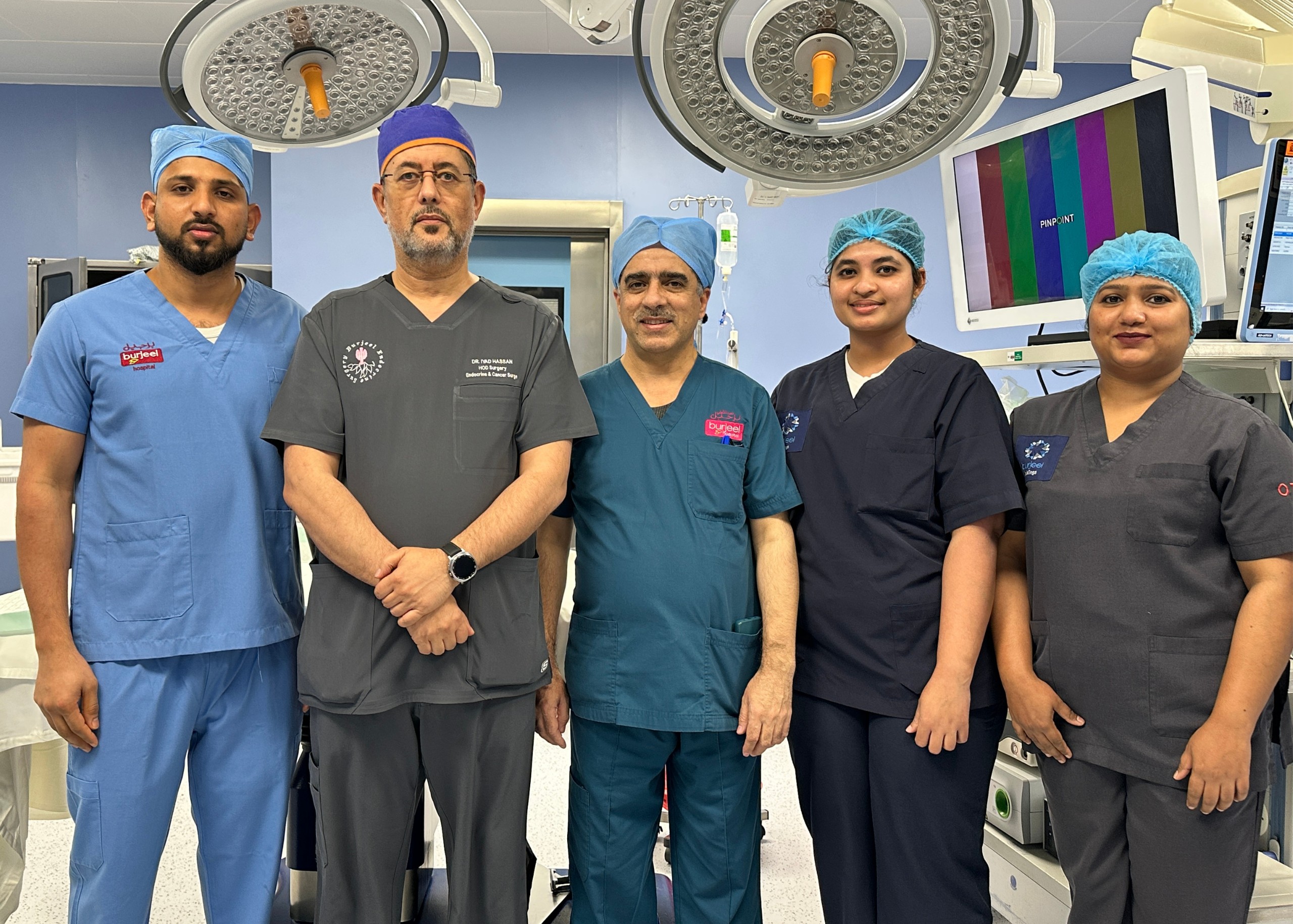
After living for years with a thyroid nearly 20 times its normal size and extending into his chest, Mohammed Bakheet underwent a minimally invasive surgery that restored his breathing, sleep, and confidence.
Abu Dhabi: For more than a decade, 53-year-old Mohammed Bakheet Mohammed lived with a growing weight on his neck and on his confidence. What started as a small swelling in 2014 gradually turned into a massive goiter that was impossible to hide. The enlargement pressed on his throat, made breathing uncomfortable, caused loud snoring at night, and often drew curious or uncomfortable stares in public. Strangers would ask questions. Friends would notice. Mohammed learned to live with it, but it was never easy.
“I adapted over time. But it affected my energy and changed how I looked,” said Mohammed.
Now a father of three and working in hotel accounting for more than 25 years, Mohammed moved to the UAE in 2019. By then, the swelling had become severe. The unusually large thyroid and its extension into the chest made the surgery high risk. The thyroid had grown unusually large and extended down into the chest, raising concerns about nerve damage, permanent calcium imbalance, and bleeding.
“I did feel hopeless,” Mohammed admitted.
That changed when he reached Burjeel Hospital, Abu Dhabi, where his case was assessed by Prof. Dr. Iyad Hassan, Head of Department and Consultant General, Endocrine, and Cancer Surgeon.
“When he came to us, the thyroid gland weighed nearly 400 grams. A normal thyroid weighs around 20 grams. This one was almost 20 times larger and had extended behind the breastbone into the upper chest,” Prof. Iyad explained.
Large goiters of this nature are among the most complex endocrine surgeries. The thyroid lies close to the vocal cord nerves, the parathyroid glands that regulate calcium, and major blood vessels. In many cases, surgeons are forced to open the chest to remove the gland.
In Mohammed’s case, Prof. Iyad and his team chose a different path.
In just 40 minutes, the entire thyroid was removed through a small 4 cm incision in the neck. No chest opening. No surgical drain. No compromise on safety. One of the key tools was the Burjeel ICG Near-Infrared Fluorescence protocol. During surgery, a special dye allows the parathyroid glands to glow under a near-infrared camera, making them clearly visible and protecting them from accidental damage.
“These glands are tiny but essential. Preserving them prevents dangerous drops in calcium after surgery,” Prof. Iyad said. At the same time, the Abu Dhabi Neural Mapping Protocol was used to continuously monitor the nerves controlling the vocal cords.
“This real-time nerve monitoring allows us to protect the patient’s voice throughout the operation. Hoarseness is one of the most feared complications in thyroid surgery,” the doctor said.
Despite the gland’s size and the risks involved, the operation was completed without injury to the nerves or parathyroid glands and with minimal blood loss. Twelve days later, Mohammed returned for follow-up. The difference was immediate.
He was breathing comfortably. Sleeping without snoring. Free from the pressure in his neck. The swelling that had followed him for years was gone. “My life has completely changed. I feel more positive. I can breathe properly and sleep well again,” he said.
He was also surprised by how small the incision was and how quickly he recovered. “I expected a long recovery, but it was much faster than I imagined,” Mohammed said.
For Prof. Iyad, the success of the surgery is measured not only by clinical outcomes but also by the patient’s return to a normal life. “The key indicators were simple. A normal voice, stable calcium levels, minimal pain, and a patient who feels like himself again,” the doctor said.
Today, Mohammed no longer has to answer uncomfortable questions about his appearance. The burden he carried for years, both physical and social, has been lifted. Asked what he would say to others living with similar conditions, his answer is straightforward.
“Trust in God and do not be afraid. Seek help at the right place. I am grateful to Dr. Iyad, his team, and everyone at Burjeel Hospital for their care and professionalism,” he said.
For one man, four numbers now define a turning point in his life. A 4 cm incision. A 40-minute surgery. A 400-gram gland removed. And the freedom to live without fear, discomfort, or hesitation once again.